"I can update myself safely, provided someone remembers the word rollback."
A Cautious Continual Learner
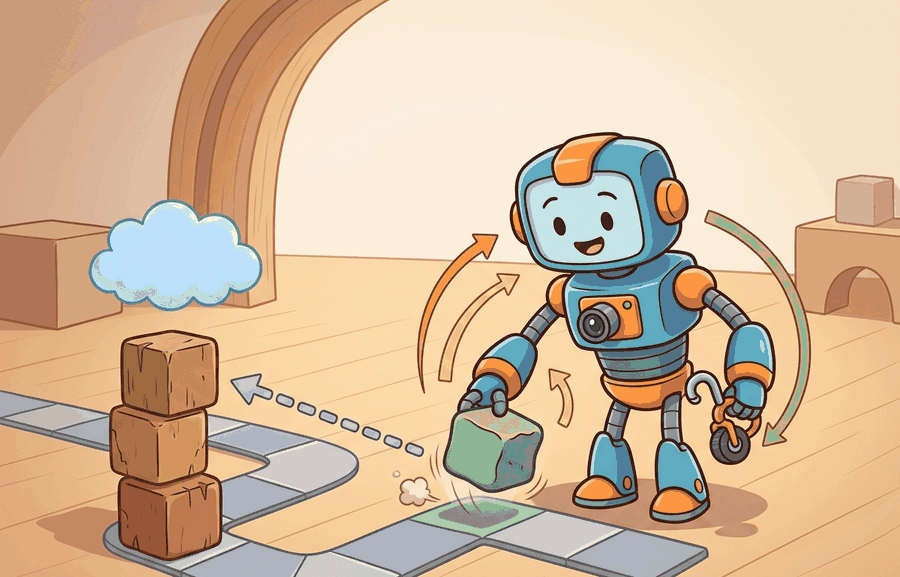
Safe continual learning; evaluation over time means treating model quality as a trajectory over versions, not as one isolated checkpoint.
Safety in continual learning is mostly about release discipline. A candidate update becomes dangerous not only when it is wrong, but when the system lacks enough versioned evidence to know that it is wrong quickly.
Theory
Prequential and versioned evaluation track performance as the environment changes over time. A minimal safety gate evaluates
$$G_t = [\Delta_{\text{new}} \ge \tau_{\text{gain}}] \land [F_t \le \tau_{\text{forget}}] \land [S_t \le \tau_{\text{safety}}] \land [\text{rollback\_ready}],$$
where $\Delta_{\text{new}}$ is gain on new tasks, $F_t$ is forgetting, and $S_t$ is safety-event rate. Promotion should require the entire gate to pass.
| Variable | What It Measures | Why It Matters |
|---|---|---|
| $\Delta_{\text{new}}$ | gain on the new distribution | justifies adaptation effort |
| $F_t$ | retained-task degradation | protects prior competence |
| $S_t$ | safety-event or intervention rate | prevents unsafe promotion |
| rollback_ready | operational reversibility | limits blast radius of mistakes |
Worked Example
A warehouse robot update may improve navigation around new shelving layouts, but it should still be blocked if safety-event rate rises or rollback is not prepared.
gate = {
    "new_task_gain": 0.07,
    "forgetting": 0.02,
    "safety_event_rate": 0.0,
    "rollback_ready": True,
}
accept = (
    gate["new_task_gain"] >= 0.03
    and gate["forgetting"] <= 0.03
    and gate["safety_event_rate"] <= 0.005
    and gate["rollback_ready"]
)
print({"accept": accept, **gate})
{'accept': True, 'new_task_gain': 0.07, 'forgetting': 0.02, 'safety_event_rate': 0.0, 'rollback_ready': True}The expected output should support a release decision directly. A model that gains more on new tasks but fails rollback readiness or safety rate should still be rejected.
- Track each model version against fixed old-task, new-task, and safety panels.
- Compute gain, forgetting, calibration, and intervention rates for each version.
- Promote only through shadow and canary phases.
- Roll back immediately when a gate condition fails.
- Store every version's decision artifact for later audit.
Versioned model registries, rollout controllers, and experiment trackers help only if they preserve per-version evidence, rollback pointers, and panel definitions. A registry without evaluation provenance is just a storage service.
Temporal evaluation is often too short. A candidate may look stable over one day but fail after enough distribution shift, maintenance drift, or operator behavior changes accumulate.
A fleet AMR update may improve congestion handling in a new warehouse layout, but the deployment team should still require a versioned record of old-layout performance, charger-docking reliability, intervention rate, and rollback readiness before expansion beyond a canary zone.
A major frontier is evaluating adaptation over long horizons where data distribution, hardware wear, and human workflows co-evolve. Short benchmark windows do not fully capture those coupled dynamics.
Can you state the thresholds for gain, forgetting, safety, and rollback readiness that define promotion in your setting? If not, the release gate is still qualitative rather than operational.
Evaluation over time should also preserve rare-event slices. A candidate update may improve daily averages while regressing on low-frequency but high-cost events such as near-collision recoveries, charger docking retries, or human handoff failures.
In a real deployment stack, this means keeping a version timeline that joins the model registry, shadow metrics, canary allocation, intervention budget, and rollback event log. Prometheus or Grafana dashboards, registry manifests, and replay archives are helpful because they expose drift and rare-event regressions across weeks rather than single evaluation windows. The scientific question is whether the team can show when competence improved, when risk rose, and exactly which version boundary caused the change.
Many teams operationalize this with PyTorch or JAX model versions, ROS 2 event logs, Prometheus counters for interventions, and Weights and Biases run lineage for the candidate update. The value of this stack is not fashionable tooling; it is the ability to ask a precise question such as which canary batch first showed a rise in monitor alarms, then recover the exact replay slice and rollback target that closed the incident. Without that chain, continual learning remains hard to audit over long horizons.
Long-horizon evaluation also has to account for changing hardware and workflow conditions. A fleet may receive a software update at the same time that wheel wear increases, battery behavior shifts with temperature, or operators begin using a different override pattern. A serious continual-learning audit therefore keeps maintenance records, embodiment identifiers, and operational context linked to the versioned evidence bundle. Otherwise the team may attribute a safety regression to learning when the real cause was a coupled shift in hardware, environment, or human procedure.
Safe continual learning depends on versioned evidence, staged rollout, and rollback readiness, not on optimism about adaptation alone.
Define a promotion gate for a humanoid locomotion update. Include thresholds for new-task gain, forgetting, intervention rate, and rollback readiness.
Section References
Kirkpatrick, J. et al. Overcoming catastrophic forgetting in neural networks. PNAS, 2017.
Use for regularization-based retention and its assumptions.
Lopez-Paz, D. and Ranzato, M. Gradient Episodic Memory for Continual Learning. NeurIPS, 2017.
Use for replay-constrained updates and task-stream evaluation.
What's Next?
Next, move to Chapter 58, where these mechanisms connect to broader frontier questions.