"I mastered the new drawer and now salute every chair like a handle."
A Forgetful Adaptation Run
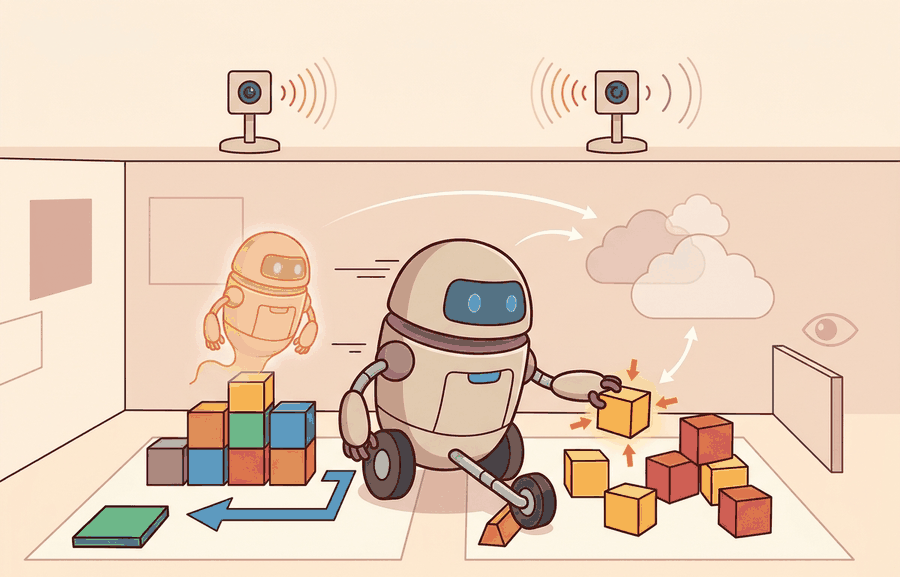
Catastrophic forgetting and mitigation should be evaluated by holding old-skill and new-task panels side by side in one artifact.
Forgetting is not an afterthought metric. It is the main reason post-deployment learning can destroy trust, because regressions often appear in tasks that operators assume are already solved.
Theory
Forgetting is a multi-objective optimization problem. One common mitigation is elastic weight consolidation, which adds a penalty
$$L(\theta)=L_{\text{new}}(\theta)+\lambda\sum_i F_i(\theta_i-\theta_i^\star)^2,$$
where $F_i$ measures the importance of parameter $i$ to old tasks. Replay methods preserve old behavior by mixing previous data into the update. Adapter or parameter-isolation methods reduce interference by localizing the new update.
| Family | Main Idea | Strength | Weakness |
|---|---|---|---|
| Replay | mix old data with new data | directly preserves behavior distribution | sampling strategy is critical |
| Regularization | penalize movement of important parameters | small memory overhead | importance estimates can be crude |
| Parameter isolation | route new learning into separate adapters or modules | reduces interference cleanly | capacity growth and routing complexity |
Worked Example
A domestic manipulation policy learns a new drawer-opening style. The correct evaluation compares drawer performance gain against retained cup-grasp and bottle-pick performance in the same run.
The expected output is useful only when both numbers come from one fixed evaluation setup. If old-task and new-task metrics come from different runs or distributions, the forgetting estimate is not trustworthy.
- Define the protected old-skill set before training.
- Choose one mitigation family: replay, regularization, or parameter isolation.
- Evaluate old and new tasks on one common artifact.
- Reject updates that exceed the forgetting budget even if new-task score improves.
- Inspect failure cases to learn whether interference is perceptual, motor, or representational.
Replay buffers, adapter or LoRA libraries, and continual-learning research codebases can speed implementation, but only when the surrounding evaluation stack measures retained-task performance on the same artifact as new-task gain.
Mitigation methods can hide forgetting if the retained-task panel is too easy or too small. Preserve hard old cases, not only the most canonical ones.
A grocery-picking robot that adapts to glossy cereal boxes may quietly lose skill on transparent bottle grasps if the update overfits visual features. Replay of difficult bottle examples or adapter isolation can preserve that competence while still improving the new category.
A current frontier is selective replay and parameter routing at scale: which old examples and which subnetworks matter most for preserving robot skills across changing tasks and embodiments?
Can you define a protected skill set and a forgetting budget for one robot policy? If not, mitigation choices like replay or EWC cannot be evaluated rigorously.
In embodied systems, forgetting often appears first at interfaces: action timing, contact handling, or human-aware clearance may degrade before the headline task success metric changes noticeably. Retained-task panels should therefore include those interface-sensitive slices.
A mature continual-learning stack therefore maintains more than class labels or success rates. It keeps a protected replay panel with contact-rich failures, timing-sensitive episodes, and human-interaction edge cases, then co-evaluates those slices with the new task on the same code revision and seed family. Toolkits such as Avalanche or adapter-based fine-tuning libraries help organize the update, but the decisive scientific object is still the matched retained-task artifact.
In practice, many teams build the update in PyTorch, store the retained-task panel in a replay service, and inspect intervention traces in ROS 2 or simulation replays before promotion. The expected output from the earlier code fragment matters because the forgetting value is not merely a summary number; it is a release trigger that should send the operator directly to the old-task replay bundle that explains which contact mode, object family, or timing slice degraded.
It is also useful to separate where forgetting originates. A policy may forget because the representation drifted, because the controller overfit a narrow contact regime, or because the new data changed the state distribution seen by the planner. Those cases require different repairs. Replay is often strongest when old and new failures share geometry but differ in frequency; adapter isolation is often cleaner when the new skill is distinct enough to deserve its own parameter path; regularization is attractive when the deployment budget cannot store or replay much prior data. The section should therefore be read as a diagnosis problem first and a mitigation-choice problem second. That diagnostic stance is what keeps the mitigation choice scientific instead of habitual, local, or automatic.
Continual learning is not successful if new-task gain is purchased by silent loss of older skills.
Choose replay, EWC, or adapters for a grasp policy that must learn a new object family without losing bottle-pick skill. Justify your choice and define the forgetting budget.
Section References
Kirkpatrick, J. et al. Overcoming catastrophic forgetting in neural networks. PNAS, 2017.
Use for regularization-based retention and its assumptions.
Lopez-Paz, D. and Ranzato, M. Gradient Episodic Memory for Continual Learning. NeurIPS, 2017.
Use for replay-constrained updates and task-stream evaluation.
What's Next?
Next, continue with Section 57.3, where human correction becomes a data source for adaptation.