For Logging, monitoring, model updates, deployment quality is measured by the command stream, safety monitor state, and replayable evidence behind each command.
A Careful Control Loop
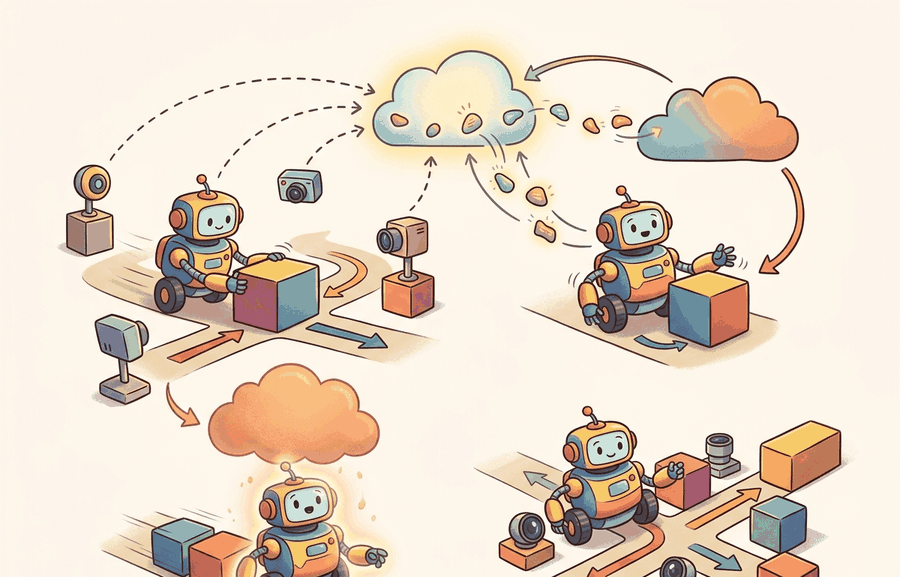
Logging, monitoring, model updates matters because logs and monitors make deployment scientifically inspectable. The section treats evaluation, uncertainty, safety, and deployment as one closed-loop contract rather than as separate checklist items.
Problem First
Without structured logs, teams cannot tell whether a failure came from perception, planning, control, timing, model drift, or operator context.
The practical question is therefore specific: which observation arrives, which state estimate is trusted, which action is allowed, which monitor can interrupt it, and which artifact proves the claim afterward?
Every compared number in this section should be co-computed by one script on one task panel, with one seed plan and one saved artifact. That artifact carries success, failure, latency, safety, and robustness fields together.
Theory
Observability is the difference between a repeatable incident review and a post hoc story. The deployment trace should align observations, estimated state, chosen action, model version, latency, monitor transitions, and operator interventions on a shared time axis.
A useful observability tuple is
$$o_i = (t_i, y_i, \hat s_i, a_i, v_i, q_i, m_i, u_i),$$
where $v_i$ is the version id, $q_i$ is queue and latency telemetry, $m_i$ is the monitor state, and $u_i$ is any human intervention. Model updates should be promoted only if a canary or shadow evaluation shows gain without violating retained-skill or safety thresholds.
The mechanism is observe, estimate, choose, constrain, execute, monitor, log, and review. Each verb has an owner in the deployment architecture and a field in the evaluation artifact.
Worked Example
Suppose a grasp update improves carton picks but causes unexpected failures on reflective packaging. A deployment trace must answer whether the change came from model weights, input distribution drift, calibration drift, or monitor-threshold edits.
required_fields = {
    "timestamp", "obs_hash", "state_estimate", "action", "model_version",
    "queue_age_ms", "monitor_state", "operator_event"
}
logged_fields = {
    "timestamp", "obs_hash", "state_estimate", "action", "model_version",
    "monitor_state",
}

# Coverage: unique logged fields that match required fields, divided by total required fields.
coverage = len(required_fields & logged_fields) / len(required_fields)
update_gate = {
    "candidate_version": "grasp_v12",
    "shadow_panel_passed": True,
    "rollback_ready": True,
    "diagnostic_coverage": coverage,
}
print(update_gate)
{'candidate_version': 'grasp_v12', 'shadow_panel_passed': True, 'rollback_ready': True, 'diagnostic_coverage': 0.75}The expected output is not just a green status. The key interpretation is that promotion is unjustified unless the update is both measurable and reversible. A candidate with improved task score but incomplete diagnostic coverage should still be rejected.
- Log all required fields for the current production version.
- Run the candidate in shadow mode on the same observation stream.
- Compare retained-skill metrics, new-task metrics, and monitor-trigger counts on one panel.
- Promote to a canary slice only if rollback is already prepared.
- Roll back immediately if safety events or retained-skill regressions cross threshold.
The hand-built record is about 24 lines. In a production run, DVC, MLflow, Weights and Biases Artifacts, or a ROS 2 bag plus metadata file reduces the tracking code to a few calls while handling versioning, file storage, run ids, and reproducible retrieval. The hand-built version remains useful because it shows which fields the tool must preserve.
Practical Recipe
- Write the observation, action, monitor, metric, and artifact fields before selecting a model.
- Run a deterministic smoke test and one named perturbation from the panel.
- Log success, safety events, latency, energy or resource use, and recovery status in the same row group.
- Compare only methods evaluated by the same script on the same panel and seed plan.
- Attach a short postmortem to each failed rollout so the artifact remains useful after the plot is forgotten.
An update that changes weights, thresholds, and data preprocessing simultaneously is practically unreviewable. Separate those moves or the logs will not support causal diagnosis.
An embodied AI team applying Logging, monitoring, model updates should review a single run folder containing configuration, model version, rollout traces, monitor transitions, video or sensor replay, and the metric table. The review asks whether the evidence supports the deployment decision, not whether one isolated number looks good.
Robot operations is developing toward continuous evaluation: every model update carries a shadow run, canary panel, rollback trigger, and post-deployment drift monitor.
Can you name the metric contract, perturbation panel, monitor state, and artifact id for Logging, monitoring, model updates? If any field is missing, the claim is not yet audit-ready.
Logging, monitoring, model updates becomes operational when the metric is tied to a runtime interface. The interface names the sensor stream, state estimate, action representation, timing budget, safety or robustness monitor, and deployment artifact.
The disciplined habit is to separate three claims. The conceptual claim explains why the method should help. The systems claim explains which interface it changes. The evidence claim records which measurement would convince a skeptical builder.
| Tool or Library | Role in Logging, monitoring, model updates |
|---|---|
| ROS 2 bags | Record time-aligned robot topics for replay and incident review. |
| Prometheus | Tracks fleet health metrics and alert thresholds. |
| artifact registry | Connects model updates with evaluation and rollback evidence. |
Cross-References
For Logging, monitoring, model updates, connect benchmark design, sim-to-real transfer, uncertainty, and safety barriers through the deployment artifact that will be checked before release.
Create a JSON or Parquet artifact for five rollouts of Logging, monitoring, model updates. Include fields for configuration, seed, perturbation, metric values, monitor state, and a short failure label. Then rerun the same panel with one changed policy setting and verify that both methods can be compared row by row.
When an update misbehaves, assign the failure to data drift, instrumentation gap, threshold drift, model regression, or release-process error. Then replay one canonical incident against both the previous and current version with identical telemetry collection.
For Logging, monitoring, model updates, schema strictness is cheaper than discovering a missing field during a moving-robot trial; require the log before comparing outcomes.
Logging, monitoring, model updates is valuable when it changes the closed-loop decision and leaves behind evidence that another builder can audit.
Design a same-artifact evaluation for this section. Specify the environment, rollout panel, seed plan, metric fields, monitor fields, one perturbation, and one rollback or recovery rule.
Section References
Quigley, M. et al. ROS: an open-source Robot Operating System. ICRA Workshop, 2009.
Use for the robotics middleware lineage behind nodes, topics, services, bags, and deployment boundaries.
OpenTelemetry project documentation. https://opentelemetry.io/docs/
Use for tracing, metrics, and logs when robot deployment evidence must connect software events to runtime behavior.
After Logging, monitoring, model updates, the next section should reuse the artifact schema while changing one deployment interface or failure mode, so comparisons remain auditable.