Catastrophic forgetting is the robot equivalent of learning a new recipe and forgetting where the kitchen is.
A Lifelong Learner
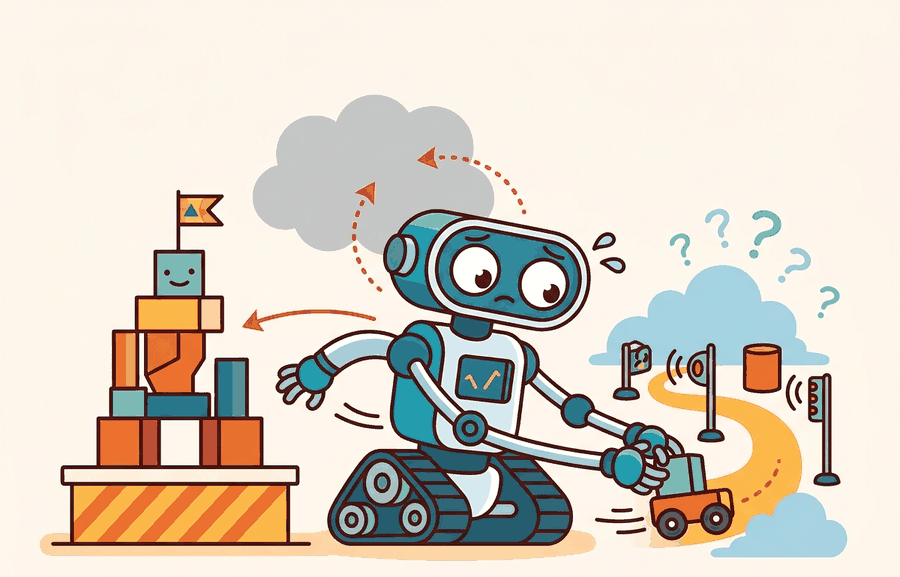
Distribution shift triggers for online adaptation is the open-world readiness lens for this section. Novel object classes, environment layout changes, and instruction vocabulary expansion are the signals that tell an embodied agent its training distribution no longer applies. This section addresses when covariate shift becomes severe enough to require active adaptation, and which evidence pattern distinguishes recoverable shift from a full distribution break.
The algorithmic treatment of catastrophic forgetting and continual learning is in Section 57.2. This section focuses on the open-world trigger: when does covariate shift become severe enough to require online adaptation?
Distribution shift detection becomes useful when it is tied to a named interface, a replayable scenario, a failure diagnostic, and an artifact that records what changed in the action loop.
The key question is practical: What open-world signals indicate that the current policy is operating out of distribution, and at what severity threshold should the agent pause, request help, or trigger a targeted update?
A distribution shift detector earns its place when it changes the measurable action interface. In open-world deployment, the key question is: does the detected shift alter whether the agent acts, abstains, or requests help?
Theory
For distribution shift triggers, the practical design rule is to make the detection interface inspectable before optimization begins: what observation features signal shift, what threshold triggers adaptation, and what log records the transition from normal operation to recovery mode.
The mechanism for open-world shift detection is a comparison between the current observation distribution and the training distribution. When that gap exceeds a calibrated threshold, the agent should slow down, flag the novelty, and choose a safe fallback rather than applying its policy overconfidently.
Worked Example
Consider a mobile manipulator deployed into a warehouse after a shelf reconfiguration. New object classes appear, aisle geometry changes, and lighting conditions shift. The question is not how to retrain immediately, but how to detect which of these changes pushes the policy outside its competent operating range.
# pip install gymnasium
import gymnasium as gym

env = gym.make("CartPole-v1")
obs, info = env.reset(seed=7)
for step in range(5):
    action = env.action_space.sample()
    obs, reward, terminated, truncated, info = env.step(action)
print(step, action, reward, terminated or truncated)The Gymnasium loop shows repeated interaction in a few lines. Practical continual learning uses replay buffers, frozen evaluation panels, versioned datasets, and deployment logs; those tools preserve old evidence while the simple loop shows where each new episode enters the update.
Practical Recipe
- Write the observation, action, and success metric before choosing a model.
- Build a baseline that is simple enough to debug by inspection.
- Add the library implementation only after the baseline behavior is understood.
- Record failures as structured cases: perception error, state error, planning error, control error, or evaluation error.
- Run at least one perturbation test before trusting the result.
The common mistake in open-world deployment is to keep running the existing policy when confidence drops, treating low confidence as a metric rather than an action gate. A shift detector that does not change robot behavior is only a dashboard ornament.
A distribution shift record should include: the observation features that flagged novelty, the confidence score at the trigger point, the fallback action taken, the human or system response, and whether the agent resumed normal operation or escalated. That record makes the trigger auditable and reproducible.
Current work on open-world shift detection studies energy-based OOD scoring, feature-space anomaly detection, world-model prediction error as a shift signal, and confidence calibration for embodied policies. The strongest results connect the shift signal directly to a change in robot behavior rather than reporting it as a passive metric.
DreamerV3 (Hafner et al., 2023) uses world-model prediction error as an implicit shift signal: when the latent dynamics model cannot predict the next observation accurately, that prediction error itself flags that the agent may be outside its training distribution. GR00T N1.5 (NVIDIA, 2024) addresses the related problem of embodiment shift: the cross-embodiment pretraining distribution provides a broad prior, and per-robot fine-tuning is gated by performance on a retained evaluation set, making the adaptation trigger explicit rather than continuous.
Can you name the observation features that signal distribution shift, the threshold that triggers action, the fallback behavior, and the log entry that records what happened? If not, the shift-detection contract is still too vague.
Distribution shift detection becomes useful when it is tied to a closed-loop contract for Open-World and Novelty-Robust Embodiment. The contract names the observation features monitored, the confidence threshold, the fallback action, the logging artifact, and the recovery rule. Without that contract, a system can appear robust in a notebook while failing silently when a deployment scene changes.
For distribution shift triggers, separate the conceptual claim (shift happened), the systems claim (the agent detected it), and the evidence claim (detection changed behavior safely). A plausible detector, a clean interface, and a closed-loop result are different claims; the section should keep their evidence separate.
| Tool or Library | Role in the Topic | Builder Advice |
|---|---|---|
| Gymnasium | Distribution shift triggers and open-world adaptation | Create controlled shifts that separate closed-world competence from open-world recovery. |
| LeRobot | Distribution shift triggers and open-world adaptation | Reuse recorded robot episodes for replay, adaptation, and regression checks. |
| ROS 2 | Distribution shift triggers and open-world adaptation | Log deployment events and safety interventions while the environment changes. |
| MuJoCo | Distribution shift triggers and open-world adaptation | Inject object, contact, and dynamics variation before real deployment. |
| PettingZoo | Distribution shift triggers and open-world adaptation | Model open-world interaction when other agents create changing goals or hazards. |
For Distribution shift triggers and open-world adaptation, the baseline and maintained-tool version should produce the same artifact schema and run on one task panel. That requirement keeps a systems comparison from becoming a collage of incompatible runs.
- Write a one-paragraph task contract with observation, action, success, and failure fields.
- Start with the smallest simulator, dataset, or wrapper that exposes the task contract faithfully.
- Run one deterministic smoke test and one perturbation test before scaling.
- Save a single result artifact containing configuration, seed, metrics, videos or traces, and failure labels.
- Compare methods only when one script evaluates them on the same task panel.
When Distribution shift triggers and open-world adaptation fails, avoid labeling the whole method as weak. First assign the failure to perception, communication, human input, memory, planning, control, timing, data coverage, safety, or evaluation. Then rerun one controlled perturbation that isolates the suspected cause. This pattern turns a disappointing rollout into a reusable diagnostic asset.
Agent Checklist Applied
The 42-agent production pass treats distribution shift detection as a buildable system, not a definition. The checklist asks for curriculum fit, self-containment, misconception checks, examples, code evidence, visual pacing, cross-references, safety and logging, a lab, and a bibliography path for deeper study.
For Distribution shift triggers and open-world adaptation, connect partial observability, exploration, memory, robustness, and evaluation through a lifelong-learning log that records what changed and how the robot noticed.
A common misconception is that distribution shift always requires immediate retraining. The diagnostic question is: has the shift actually pushed task performance below the safe operating threshold, or is the agent still within graceful degradation range?
Build a two-condition panel: one familiar scene and one shifted scene. Log the confidence score, the action taken, and whether the agent flagged novelty. Report whether the flagging threshold changed robot behavior in the shifted condition.
A shift detector without an action gate is like a smoke alarm wired to a speaker but not to the sprinklers.
Technical Core
Distribution shift triggers and open-world adaptation needs a topic-native core: variables, equations or system contracts, an algorithmic procedure, an expected output, and a failure diagnosis. Figure 51.4.T summarizes the chain this section must preserve when moving from a teaching example to a real embodied system.
$d_t = D_{\mathrm{KL}}(p_{\mathrm{deploy}}(o_t) \,\|\, p_{\mathrm{train}}(o)),\quad \text{trigger adaptation if } d_t \ge \delta$
The open-world shift trigger compares the current observation distribution to the training distribution. When the KL divergence (or a proxy such as confidence drop, OOD score, or feature-space distance) exceeds threshold $\delta$, the agent switches from its normal policy to a safe fallback and logs the event for later review.
- Monitor a shift signal on every inference step: confidence score, feature-space distance, or an explicit OOD detector.
- Compare the signal against a calibrated threshold derived from held-out in-distribution data.
- On threshold crossing: execute the fallback action (slow down, request help, or switch to exploration), and log the observation, signal value, and chosen fallback.
- Resume normal operation only after the shift signal falls back below threshold for a sustained window, or after a targeted adaptation step is verified on a retention panel.
| Signal | What It Measures | Embodied Tradeoff |
|---|---|---|
| Softmax confidence drop | Policy uncertainty on current observation. | Fast but overconfident on OOD inputs. |
| Feature-space distance | Distance from nearest training cluster. | Requires stored feature index; more reliable. |
| Energy-based OOD score | Log-sum-exp of logits as a free-energy proxy. | Better calibrated than raw softmax confidence. |
| Prediction error on world model | Reconstruction or next-state error from a learned model. | Catches dynamics shift, not just appearance shift. |
# Detect whether current observation is out-of-distribution.
import math

logits = [2.1, 0.4, -0.9, 1.3]
energy = -math.log(sum(math.exp(x) for x in logits))
threshold = -1.5  # calibrated on in-distribution validation set

decision = "fallback" if energy < threshold else "act"
print(f"energy={energy:.3f}  decision={decision}")
energy=-2.486 decision=fallback
The negative energy score is below the threshold, so the agent abstains. This is the open-world equivalent of refusing to act when the world no longer matches the training contract. The algorithmic treatment of what happens next (how to update safely without forgetting) is covered in Section 57.2.
Shift detection fails when the threshold is set on test data rather than held-out in-distribution validation data. Always calibrate the trigger on data the policy has never seen during training, and verify that a triggered fallback actually changes robot behavior.
Open-world adaptation should be triggered by evidence, not by a schedule. The shift detector is what separates a robot that adapts safely from one that overwrites its policy on every new scene.
Design a method-matched experiment for distribution shift detection in an open-world setting. Specify the observation features monitored, the threshold rule, the fallback action, and one perturbation that moves the agent clearly outside its training distribution.
Section References
Parisi, G. I. et al. Continual Lifelong Learning with Neural Networks: A Review. Neural Networks, 2019.
Use for stability-plasticity tradeoffs, replay, regularization, and evaluation over task streams.
Kirkpatrick, J. et al. Overcoming catastrophic forgetting in neural networks. PNAS, 2017.
Use for elastic weight consolidation and the limits of parameter-importance methods.