A robot cannot apologize its way out of a data-retention policy.
A Data-Retention Policy
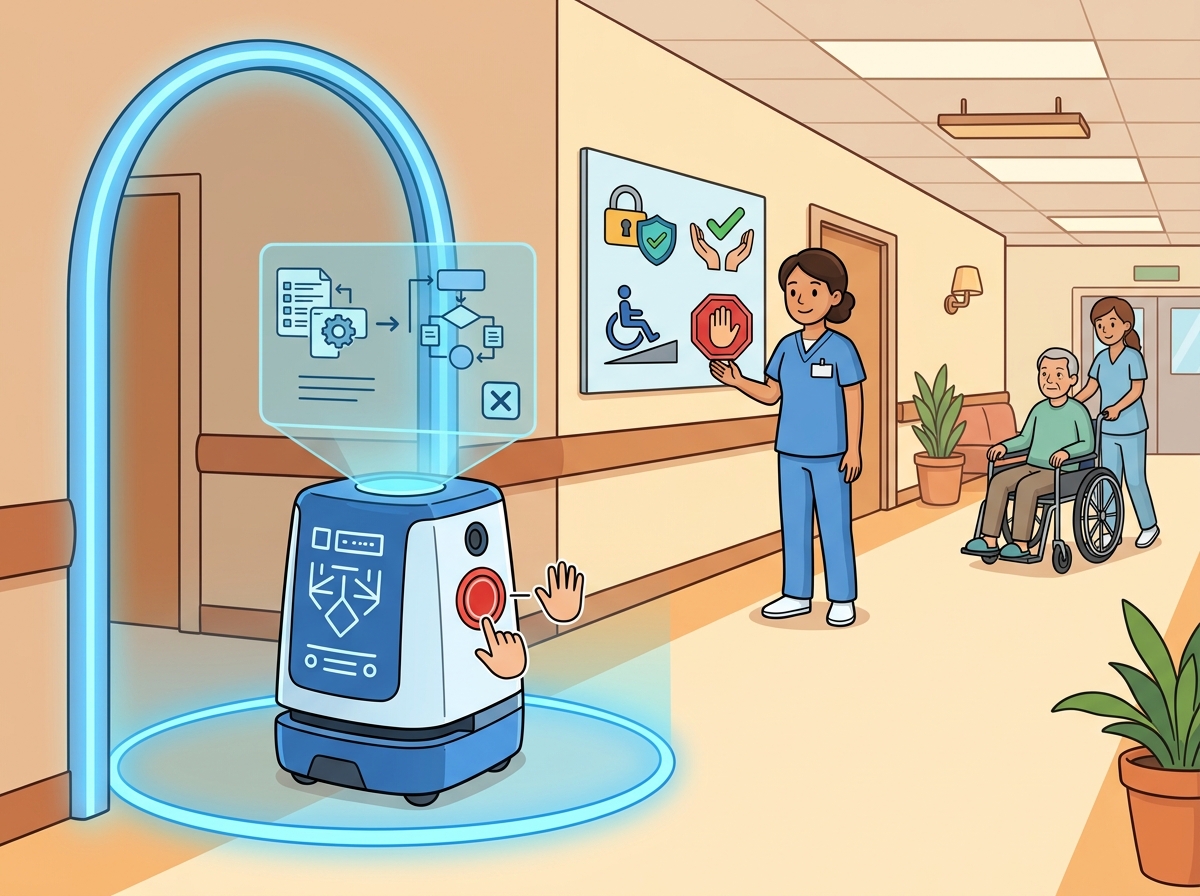
Ethical concerns is the accountability in human-facing embodiment lens for human-robot interaction. Ethics in HRI is operational: privacy, consent, fairness, accessibility, dignity, and accountability must appear in requirements, logs, and stop conditions.
ethical concerns becomes useful when it is tied to a named interface, a replayable scenario, a failure diagnostic, and an artifact that records what changed in the action loop.
The key question is practical: Who is affected, what data is collected, what action can harm them, and who can inspect or stop the system?
Figure 50.6A makes the core design demand visible: the same system that acts in public must also expose who can consent, intervene, audit, and shut it down.
A representation earns its place when it changes the measurable action interface. In ethical concerns, the reader should keep asking which decision becomes easier, safer, or more reliable.
Theory
For Ethical concerns, the practical design rule is to make the interface inspectable before optimization begins: inputs, outputs, units, latency, bounds, and failure labels should all be visible in the saved artifact.
The mechanism in Ethical concerns is the contract between representation and action. Name what enters the module, what leaves it, which assumptions make that transformation valid, and which log would reveal a bad handoff.
Worked Example
Consider a care robot that records speech and movement to provide assistance. The system needs consent boundaries, data minimization, bias checks, transparent fallbacks, and human escalation.
The hand-built fragment names a step in about 12 lines. In practice, use deployment checklists, ROS 2 event logging, access controls, and human-study protocols; the tools enforce reviewable procedures while the small version keeps the ethical object of concern visible.
Practical Recipe
- Write the observation, action, and success metric before choosing a model.
- Build a baseline that is simple enough to debug by inspection.
- Add the library implementation only after the baseline behavior is understood.
- Record failures as structured cases: perception error, state error, planning error, control error, or evaluation error.
- Run at least one perturbation test before trusting the result.
The common mistake in Ethical concerns is to celebrate the component score before checking the closed-loop handoff. The failure usually appears at the boundary: stale state, wrong frame, delayed action, saturated actuator, or metric that ignores the real task cost.
An ethical deployment record should include consent state, data retained, access policy, affected user group, known limitations, intervention route, and incident review. Ethics becomes real when it changes engineering defaults.
Current HRI ethics work focuses on privacy-preserving sensing, value-sensitive design, inclusive evaluation, and governance for human-facing autonomy. Claims should distinguish design principles from validated safety evidence.
The rise of RLHF for robotics (following Ouyang et al., 2022) introduces new ethical dimensions specific to embodied systems. Preference labels encode the values of whoever rated the trajectories; if raters are not representative of the deployment population, the robot's learned objective may systematically disfavor certain users or contexts. Unlike text models where preference mismatch produces unhelpful outputs, in physical systems it can produce unsafe motion. Work from 2023 and 2024 on robot preference learning highlights the need for rater diversity audits, explicit uncertainty quantification in reward models, and human override mechanisms that remain robust even when the preference-trained policy is highly confident.
Can you name the observation, state estimate, action, success metric, and most likely failure mode for ethical concerns? If not, the system boundary is still too vague.
Ethical concerns becomes useful when it is tied to a closed-loop contract for Human-Robot Interaction. The contract names the participants, observations, action authority, timing budget, logging artifact, and recovery rule. Without that contract, a system can look capable in a notebook while failing the first time a partner delays, a person corrects it, or a deployment scene changes.
For Ethical concerns, separate the conceptual claim, the systems claim, and the evidence claim. A plausible mechanism, a clean interface, and a closed-loop result are different claims; the section should keep their evidence separate.
| Tool or Library | Role in the Topic | Builder Advice |
|---|---|---|
| ROS 2 | Ethical concerns | Represent robot state, alerts, and operator commands with inspectable interfaces. |
| LeRobot | Ethical concerns | Collect and replay human demonstrations for feedback and shared-autonomy studies. |
| MuJoCo | Ethical concerns | Prototype risky interaction policies before any human-facing trial. |
| Gymnasium | Ethical concerns | Build small decision tasks that isolate trust, intent, or feedback mechanisms. |
| PettingZoo | Ethical concerns | Model mixed human-robot roles as interacting agents when turn order matters. |
For Ethical concerns, the baseline and maintained-tool version should produce the same artifact schema and run on one task panel. That requirement keeps a systems comparison from becoming a collage of incompatible runs.
- Write a one-paragraph task contract with observation, action, success, and failure fields.
- Start with the smallest simulator, dataset, or wrapper that exposes the task contract faithfully.
- Run one deterministic smoke test and one perturbation test before scaling.
- Save a single result artifact containing configuration, seed, metrics, videos or traces, and failure labels.
- Compare methods only when one script evaluates them on the same task panel.
When Ethical concerns fails, avoid labeling the whole method as weak. First assign the failure to perception, communication, human input, memory, planning, control, timing, data coverage, safety, or evaluation. Then rerun one controlled perturbation that isolates the suspected cause. This pattern turns a disappointing rollout into a reusable diagnostic asset.
Agent Checklist Applied
The 42-agent production pass treats ethical concerns as a buildable system, not a definition. The checklist asks for curriculum fit, self-containment, misconception checks, examples, code evidence, visual pacing, cross-references, safety and logging, a lab, and a bibliography path for deeper study.
For Ethical concerns, connect HRI design to whole-body control, language guidance, teleoperation data, safety review, and deployment logging through one interaction transcript.
A common misconception is that ethics is a final review after the robot works. The diagnostic question is: which design choice changed because a user could be harmed or excluded?
Draft an HRI risk register for one scenario. Include user groups, data types, hazard, mitigation, logging, and escalation owner.
A robot cannot apologize its way out of a data-retention policy.
Technical Core
Ethical concerns needs a topic-native core: variables, equations or system contracts, an algorithmic procedure, an expected output, and a failure diagnosis. Figure 50.6.T summarizes the chain this section must preserve when moving from a teaching example to a real embodied system.
$\min_\pi \mathbb E[\ell_{\mathrm{task}}] \quad \text{subject to} \quad \mathbb E[\ell_{\mathrm{privacy}}]\le \epsilon_1,\ \mathbb E[\ell_{\mathrm{harm}}]\le \epsilon_2,\ \mathbb E[\ell_{\mathrm{exclusion}}]\le \epsilon_3$
Ethical concerns become operational when they are translated into constraints, audit artifacts, and escalation policies. Embodied systems can cause physical, social, and informational harm at the same time, which is why ethics has to enter during design rather than after deployment.
- List stakeholders, data types, control modes, and plausible harm channels.
- Map each harm channel to a measurable proxy and an owner who must respond when it spikes.
- Instrument the system to log consent state, intervention, privacy-relevant events, and exclusion cases.
- Block launch when a critical risk lacks a mitigation, rollback, or disclosure path.
| Risk | Design Lever | Evidence Artifact |
|---|---|---|
| Privacy leakage | On-device processing, retention limits, masking. | Data-flow map and deletion log. |
| Accessibility exclusion | Alternative interfaces, multimodal cues. | User-group coverage matrix. |
| Physical harm | Speed caps, force limits, stop logic. | Hazard analysis and incident replay. |
| Manipulative persuasion | Disclosure and consent controls. | Interaction transcript audit. |
This output matters because it creates accountability. An ethics paragraph without a named owner is not a control surface. A serious embodied deployment should be able to point from each risk to the code path, operating procedure, or launch gate that addresses it.
Ethics work fails when it stays qualitative while the system is quantitative. Force the team to name measurable proxies, owners, and rollback conditions; otherwise known risks will remain visible in prose but invisible in the deployment pipeline.
Ethical HRI turns values into inspectable engineering constraints and reviewable logs.
Design a method-matched experiment for Ethical concerns. Specify the environment, observation schema, action interface, metric, and one perturbation that targets the section's core assumption.
Section References
Goodrich, M. A. and Schultz, A. C. Human-Robot Interaction: A Survey. Foundations and Trends in Human-Computer Interaction, 2007.
Use for HRI vocabulary, autonomy levels, and human factors framing.
Dragan, A. D., Lee, K. C. T., and Srinivasa, S. S. Legibility and Predictability of Robot Motion. HRI, 2013.
Use for motion that communicates intent rather than merely reaching the goal.