An explanation that cannot change a decision is just a receipt for confusion.
A Transparency Budget
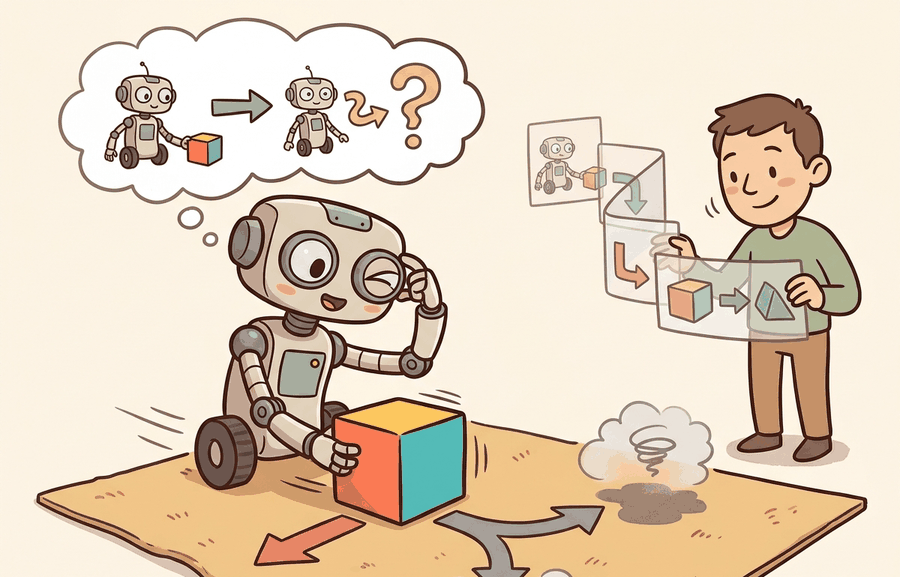
Explainable robot behavior is the legible decisions and audit trails lens for human-robot interaction. An explanation is useful when it helps a person predict, correct, or trust a robot action. It is not useful when it merely narrates an opaque policy after the fact.
explainable robot behavior becomes useful when it is tied to a named interface, a replayable scenario, a failure diagnostic, and an artifact that records what changed in the action loop.
The key question is practical: Which decision did the robot make, which evidence supported it, which alternatives were rejected, and what can a person do next?
A representation earns its place when it changes the measurable action interface. In explainable robot behavior, the reader should keep asking which decision becomes easier, safer, or more reliable.
Theory
For Explainable robot behavior, the practical design rule is to make the interface inspectable before optimization begins: inputs, outputs, units, latency, bounds, and failure labels should all be visible in the saved artifact.
The mechanism in Explainable robot behavior is the contract between representation and action. Name what enters the module, what leaves it, which assumptions make that transformation valid, and which log would reveal a bad handoff.
Worked Example
Consider a robot that refuses to enter a cluttered doorway. A good explanation names the safety constraint, the observed obstacle, the confidence, and the available recovery actions.
The hand-built fragment names one action and result in about 12 lines. In practice, pair ROS 2 event logs with templates, behavior trees, or model cards; the tools preserve state, constraint, and fallback metadata while the small version checks that every explanation has an action referent.
Practical Recipe
- Write the observation, action, and success metric before choosing a model.
- Build a baseline that is simple enough to debug by inspection.
- Add the library implementation only after the baseline behavior is understood.
- Record failures as structured cases: perception error, state error, planning error, control error, or evaluation error.
- Run at least one perturbation test before trusting the result.
The common mistake in Explainable robot behavior is to celebrate the component score before checking the closed-loop handoff. The failure usually appears at the boundary: stale state, wrong frame, delayed action, saturated actuator, or metric that ignores the real task cost.
An explanation log should include trigger, policy state, constraint, rejected alternative, user-facing message, and follow-up action. That record supports debugging and human review.
Embodied explainability is moving toward interactive explanations, counterfactuals, and safety-case evidence. Evaluate explanations with task understanding and intervention quality, not only preference ratings.
RLHF (Ouyang et al., 2022) creates a new explainability requirement: when a robot's objective is a learned preference model rather than a hand-coded reward, explaining its behavior means accounting for both the policy and the reward model it is optimizing. Work from 2023 and 2024 explores this by asking raters to compare explanation quality alongside trajectory quality, creating preference datasets that target interpretability directly. The challenge is that preference-trained reward models are opaque by design, so the open problem is building explanations that faithfully reflect what the preference model actually learned rather than what the designer intended.
Can you name the observation, state estimate, action, success metric, and most likely failure mode for explainable robot behavior? If not, the system boundary is still too vague.
Explainable robot behavior becomes useful when it is tied to a closed-loop contract for Human-Robot Interaction. The contract names the participants, observations, action authority, timing budget, logging artifact, and recovery rule. Without that contract, a system can look capable in a notebook while failing the first time a partner delays, a person corrects it, or a deployment scene changes.
For Explainable robot behavior, separate the conceptual claim, the systems claim, and the evidence claim. A plausible mechanism, a clean interface, and a closed-loop result are different claims; the section should keep their evidence separate.
| Tool or Library | Role in the Topic | Builder Advice |
|---|---|---|
| ROS 2 | Explainable robot behavior | Represent robot state, alerts, and operator commands with inspectable interfaces. |
| LeRobot | Explainable robot behavior | Collect and replay human demonstrations for feedback and shared-autonomy studies. |
| MuJoCo | Explainable robot behavior | Prototype risky interaction policies before any human-facing trial. |
| Gymnasium | Explainable robot behavior | Build small decision tasks that isolate trust, intent, or feedback mechanisms. |
| PettingZoo | Explainable robot behavior | Model mixed human-robot roles as interacting agents when turn order matters. |
For Explainable robot behavior, the baseline and maintained-tool version should produce the same artifact schema and run on one task panel. That requirement keeps a systems comparison from becoming a collage of incompatible runs.
- Write a one-paragraph task contract with observation, action, success, and failure fields.
- Start with the smallest simulator, dataset, or wrapper that exposes the task contract faithfully.
- Run one deterministic smoke test and one perturbation test before scaling.
- Save a single result artifact containing configuration, seed, metrics, videos or traces, and failure labels.
- Compare methods only when one script evaluates them on the same task panel.
When Explainable robot behavior fails, avoid labeling the whole method as weak. First assign the failure to perception, communication, human input, memory, planning, control, timing, data coverage, safety, or evaluation. Then rerun one controlled perturbation that isolates the suspected cause. This pattern turns a disappointing rollout into a reusable diagnostic asset.
Agent Checklist Applied
The 42-agent production pass treats explainable robot behavior as a buildable system, not a definition. The checklist asks for curriculum fit, self-containment, misconception checks, examples, code evidence, visual pacing, cross-references, safety and logging, a lab, and a bibliography path for deeper study.
For Explainable robot behavior, connect HRI design to whole-body control, language guidance, teleoperation data, safety review, and deployment logging through one interaction transcript.
A common misconception is that longer explanations are better. The diagnostic question is: after hearing the explanation, can the person predict the robot's next action or correct the current one?
Write three robot refusal messages for the same blocked path: too vague, too technical, and action-ready. Compare what a user could do after each.
An explanation that cannot change a decision is just a receipt for confusion.
Technical Core
Explainable robot behavior needs a topic-native core: variables, equations or system contracts, an algorithmic procedure, an expected output, and a failure diagnosis. Figure 50.4.T summarizes the chain this section must preserve when moving from a teaching example to a real embodied system.
$e_t=\operatorname{arg\,topk}_{k}\, \Delta V_k,\quad \Delta V_k = V(s_t)-V(s_t \setminus \text{factor}_k)$
Explainable robot behavior means selecting which internal factors actually changed the decision. A useful explanation is sparse, causally tied to the chosen action, and matched to the user's horizon: immediate motion, local obstacle, or higher-level task reason.
- Log the policy input, selected action, safety checks, and active planner constraints.
- Compute which factors most changed the action score or feasibility set.
- Render the explanation at the same abstraction level as the user's question.
- Verify usefulness by measuring whether the explanation changes the next human decision.
| Form | Useful When | Weakness |
|---|---|---|
| Rule-based event trace | Safety stop or mode switch happened. | Can miss learned-policy nuance. |
| Counterfactual statement | User asks "why not that way?" | Needs a faithful local model. |
| Saliency overlay | Visual attention matters. | Often descriptive, not causal. |
| Task-level summary | Longer collaborative workflows. | May hide the immediate trigger. |
# Pick the factors that most changed the stop decision.
delta = {"person_in_crosswalk": 0.62, "wet_floor_zone": 0.18, "shorter_path": -0.07}
explanation = sorted(delta.items(), key=lambda item: abs(item[1]), reverse=True)
top_factor, top_effect = explanation[0]
assert top_effect > 0, "The stop explanation should increase caution."
print({"top_factor": top_factor, "effect": top_effect, "ranked_factors": explanation})[:2]
print(explanation)
[('person_in_crosswalk', 0.62), ('wet_floor_zone', 0.18)]The ranking matters because it keeps the explanation actionable. A human hearing "I stopped because a person entered the crosswalk and the floor zone narrowed my alternatives" can decide whether to wait, redirect the robot, or clear the path. A heatmap alone would not support that decision.
An explanation system fails when it explains the model instead of the robot's action. Ask whether the explanation predicts the next behavior change under a counterfactual scene edit; if not, it is probably decorative rather than operational.
Explainable robot behavior ties each message to evidence, alternatives, constraints, and next actions.
Design a method-matched experiment for Explainable robot behavior. Specify the environment, observation schema, action interface, metric, and one perturbation that targets the section's core assumption.
Section References
Goodrich, M. A. and Schultz, A. C. Human-Robot Interaction: A Survey. Foundations and Trends in Human-Computer Interaction, 2007.
Use for HRI vocabulary, autonomy levels, and human factors framing.
Dragan, A. D., Lee, K. C. T., and Srinivasa, S. S. Legibility and Predictability of Robot Motion. HRI, 2013.
Use for motion that communicates intent rather than merely reaching the goal.