A robot that hears every word but ignores the hallway is just a chatbot on wheels.
A Chatbot on Wheels
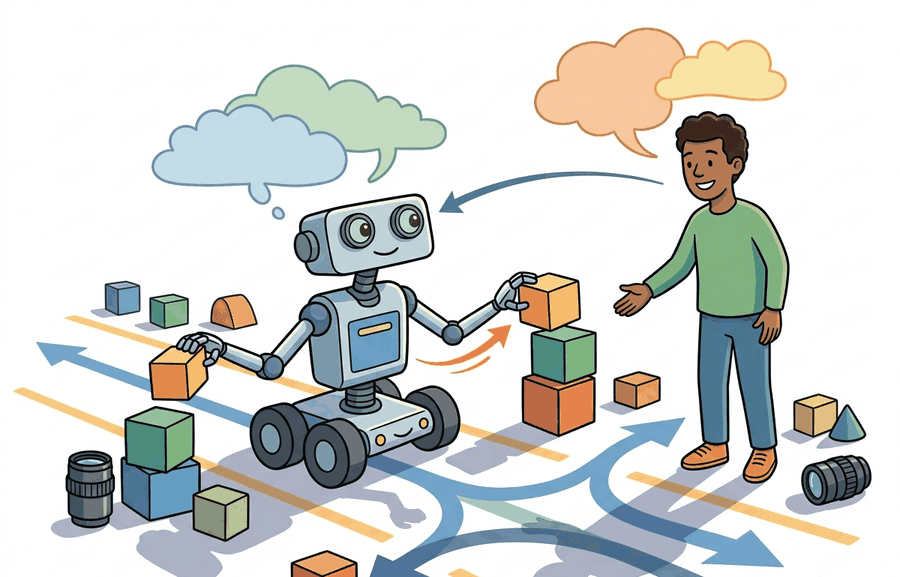
Natural-language interaction and social navigation is the language grounded in motion lens for human-robot interaction. Language is useful only when it changes grounded behavior: where the robot goes, when it yields, what it asks, and how it recovers from ambiguity.
natural-language interaction and social navigation becomes useful when it is tied to a named interface, a replayable scenario, a failure diagnostic, and an artifact that records what changed in the action loop.
The key question is practical: Which phrases map to goals, constraints, confirmations, or refusals, and how does the robot show that mapping in motion?
A representation earns its place when it changes the measurable action interface. In natural-language interaction and social navigation, the reader should keep asking which decision becomes easier, safer, or more reliable.
Theory
For Natural-language interaction and social navigation, the practical design rule is to make the interface inspectable before optimization begins: inputs, outputs, units, latency, bounds, and failure labels should all be visible in the saved artifact.
The mechanism in Natural-language interaction and social navigation is the contract between representation and action. Name what enters the module, what leaves it, which assumptions make that transformation valid, and which log would reveal a bad handoff.
Worked Example
Consider a home robot told to bring the blue mug but not disturb the sleeping person. The instruction combines object grounding, social constraint, path planning, and uncertainty communication.
The hand-built fragment names one interaction step in about 12 lines. In practice, combine ROS 2 action servers, language-grounding models, and navigation stacks; those tools handle goals, status, cancellation, and map updates while the small version keeps the command contract explicit.
Practical Recipe
- Write the observation, action, and success metric before choosing a model.
- Build a baseline that is simple enough to debug by inspection.
- Add the library implementation only after the baseline behavior is understood.
- Record failures as structured cases: perception error, state error, planning error, control error, or evaluation error.
- Run at least one perturbation test before trusting the result.
The common mistake in Natural-language interaction and social navigation is to celebrate the component score before checking the closed-loop handoff. The failure usually appears at the boundary: stale state, wrong frame, delayed action, saturated actuator, or metric that ignores the real task cost.
A language-navigation study should log user utterance, parsed intent, grounded object, social constraint, selected route, clarification question, and final outcome. The clarification is a feature, not a failure.
Current systems connect vision-language models, navigation policies, and dialogue managers, but robust social navigation still depends on context and evaluation protocol. Claims need tests with ambiguous instructions and changing people.
The RLHF technique (Ouyang et al., 2022) is entering social navigation and language-guided robotics: rather than specifying what "polite" or "helpful" navigation means in a reward function, 2023 and 2024 systems collect pairwise human judgments over robot trajectory pairs and train reward models from those comparisons. This approach captures context-sensitive preferences that are difficult to hand-code, such as giving pedestrians more space near building exits versus in open corridors, but it also inherits the alignment risks of any preference model trained on limited rater populations.
Can you name the observation, state estimate, action, success metric, and most likely failure mode for natural-language interaction and social navigation? If not, the system boundary is still too vague.
Natural-language interaction and social navigation becomes useful when it is tied to a closed-loop contract for Human-Robot Interaction. The contract names the participants, observations, action authority, timing budget, logging artifact, and recovery rule. Without that contract, a system can look capable in a notebook while failing the first time a partner delays, a person corrects it, or a deployment scene changes.
For Natural-language interaction and social navigation, separate the conceptual claim, the systems claim, and the evidence claim. A plausible mechanism, a clean interface, and a closed-loop result are different claims; the section should keep their evidence separate.
| Tool or Library | Role in the Topic | Builder Advice |
|---|---|---|
| ROS 2 | Natural-language interaction and social navigation | Represent robot state, alerts, and operator commands with inspectable interfaces. |
| LeRobot | Natural-language interaction and social navigation | Collect and replay human demonstrations for feedback and shared-autonomy studies. |
| MuJoCo | Natural-language interaction and social navigation | Prototype risky interaction policies before any human-facing trial. |
| Gymnasium | Natural-language interaction and social navigation | Build small decision tasks that isolate trust, intent, or feedback mechanisms. |
| PettingZoo | Natural-language interaction and social navigation | Model mixed human-robot roles as interacting agents when turn order matters. |
For Natural-language interaction and social navigation, the baseline and maintained-tool version should produce the same artifact schema and run on one task panel. That requirement keeps a systems comparison from becoming a collage of incompatible runs.
- Write a one-paragraph task contract with observation, action, success, and failure fields.
- Start with the smallest simulator, dataset, or wrapper that exposes the task contract faithfully.
- Run one deterministic smoke test and one perturbation test before scaling.
- Save a single result artifact containing configuration, seed, metrics, videos or traces, and failure labels.
- Compare methods only when one script evaluates them on the same task panel.
When Natural-language interaction and social navigation fails, avoid labeling the whole method as weak. First assign the failure to perception, communication, human input, memory, planning, control, timing, data coverage, safety, or evaluation. Then rerun one controlled perturbation that isolates the suspected cause. This pattern turns a disappointing rollout into a reusable diagnostic asset.
Agent Checklist Applied
The 42-agent production pass treats natural-language interaction and social navigation as a buildable system, not a definition. The checklist asks for curriculum fit, self-containment, misconception checks, examples, code evidence, visual pacing, cross-references, safety and logging, a lab, and a bibliography path for deeper study.
For Natural-language interaction and social navigation, connect HRI design to whole-body control, language guidance, teleoperation data, safety review, and deployment logging through one interaction transcript.
A common misconception is that understanding the sentence means understanding the task. The diagnostic question is: can the robot explain which physical constraint each phrase changed?
Write five household instructions with one ambiguity each. For each, record the grounding, the clarification question, and the safe default action.
A robot that hears every word but ignores the hallway is just a chatbot on wheels.
Technical Core
Natural-language interaction and social navigation needs a topic-native core: variables, equations or system contracts, an algorithmic procedure, an expected output, and a failure diagnosis. Figure 50.2.T summarizes the chain this section must preserve when moving from a teaching example to a real embodied system.
$p(g,z\mid w,o)\propto p(w\mid g)\,p(g\mid z,o)\,p(z\mid o)$
Natural-language interaction and social navigation require a grounding model, not merely a language model. The robot must infer a goal $g$, a social constraint set $z$, and the visual evidence $o$ that makes the utterance actionable in the current scene.
- Parse the utterance into action, object, destination, and soft social constraints such as "quietly" or "do not block the nurse".
- Bind noun phrases to scene entities and reject bindings whose geometry or affordances are impossible.
- Translate social constraints into path or timing costs, then plan.
- Ask a clarification question when multiple bindings remain or when the safe action set is empty.
| Error Type | Example | Corrective Action |
|---|---|---|
| Referent ambiguity | "Take this to the room" with two trays nearby. | Ask which tray or which room. |
| Affordance mismatch | Object named correctly but impossible to grasp. | Switch to a tool or ask for help. |
| Social constraint omission | Shortest path cuts through a waiting group. | Replan with a human-space penalty. |
| Temporal mismatch | Instruction assumes immediate action during a busy crossing. | Delay execution and announce intent. |
# Choose between execution and clarification.
candidates = [
    {"goal": "deliver tray to room_12", "prob": 0.52, "safe": True},
    {"goal": "deliver tray to room_14", "prob": 0.44, "safe": True},
]

margin = candidates[0]["prob"] - candidates[1]["prob"]
decision = "clarify" if margin < 0.15 else "execute"
print("margin", round(margin, 2), "decision", decision)
margin 0.08 decision clarify
The small probability margin is the important number. In a social setting the cost of a wrong confident action is usually larger than the cost of one short clarification question, especially when the robot would otherwise navigate into busy shared space.
Language-grounded navigation fails when the text parser is evaluated separately from the motion planner. Always test end-to-end cases where words change the path shape, stop condition, or social exclusion zone.
Natural language helps embodied agents when it becomes grounded goals, constraints, and recoverable dialogue.
Design a method-matched experiment for Natural-language interaction and social navigation. Specify the environment, observation schema, action interface, metric, and one perturbation that targets the section's core assumption.
Section References
Goodrich, M. A. and Schultz, A. C. Human-Robot Interaction: A Survey. Foundations and Trends in Human-Computer Interaction, 2007.
Use for HRI vocabulary, autonomy levels, and human factors framing.
Dragan, A. D., Lee, K. C. T., and Srinivasa, S. S. Legibility and Predictability of Robot Motion. HRI, 2013.
Use for motion that communicates intent rather than merely reaching the goal.