Emergence is impressive until the fire exit becomes a group project.
An Emergent Local Rule
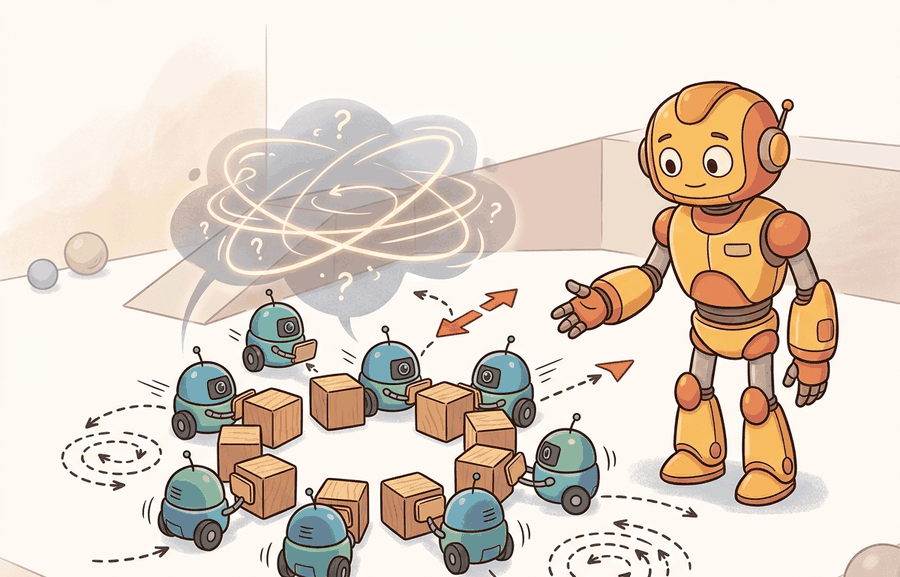
Swarms and emergent behavior; evaluating teams is the local rules and team metrics lens for multi-agent embodied AI. Swarm behavior can look intelligent even when each agent follows a tiny local rule. Evaluation must separate robust emergence from fragile choreography.
swarms and emergent behavior; evaluating teams becomes useful when it is tied to a named interface, a replayable scenario, a failure diagnostic, and an artifact that records what changed in the action loop.
The key question is practical: Which local rule, communication radius, perturbation, and team-level metric explain the observed behavior?
A representation earns its place when it changes the measurable action interface. In swarms and emergent behavior; evaluating teams, the reader should keep asking which decision becomes easier, safer, or more reliable.
Theory
For Swarms and emergent behavior; evaluating teams, the practical design rule is to make the interface inspectable before optimization begins: inputs, outputs, units, latency, bounds, and failure labels should all be visible in the saved artifact.
The mechanism in Swarms and emergent behavior; evaluating teams is the contract between representation and action. Name what enters the module, what leaves it, which assumptions make that transformation valid, and which log would reveal a bad handoff.
Worked Example
Consider twenty warehouse micro-robots spreading through aisles. A local collision-avoidance rule can create smooth flow, but the same rule may jam when one aisle closes or one robot stops reporting.
The hand-built fragment records one agent step in about 12 lines. Swarm studies should use vectorized simulators, PettingZoo-style multi-agent wrappers, or ROS 2 namespaces; these handle many agents, repeatable resets, and per-agent logs while the small version keeps the local rule readable.
Practical Recipe
- Write the observation, action, and success metric before choosing a model.
- Build a baseline that is simple enough to debug by inspection.
- Add the library implementation only after the baseline behavior is understood.
- Record failures as structured cases: perception error, state error, planning error, control error, or evaluation error.
- Run at least one perturbation test before trusting the result.
The common mistake in Swarms and emergent behavior; evaluating teams is to celebrate the component score before checking the closed-loop handoff. The failure usually appears at the boundary: stale state, wrong frame, delayed action, saturated actuator, or metric that ignores the real task cost.
A swarm evaluation should log density, communication radius, local rule version, intervention events, and team metrics such as coverage, time to recover, and worst-agent delay. Mean success alone misses herd-level failure.
Research continues on scalable coordination, embodied collectives, differentiable simulators, and sim-to-real transfer for many bodies. Useful claims include perturbation sweeps, not only polished videos.
HAPPO (Kuba et al., ICLR 2022) provides theoretical grounding for heterogeneous swarm training by showing that sequential trust-region updates across agents with different roles and observation spaces preserve a joint improvement guarantee. For swarms this matters because local rule diversity, the hallmark of emergent behavior, means agents are effectively heterogeneous even when they share a policy class; HAPPO clarifies when per-agent gradient steps are safe and when they can destabilize the collective.
Can you name the observation, state estimate, action, success metric, and most likely failure mode for swarms and emergent behavior; evaluating teams? If not, the system boundary is still too vague.
Swarms and emergent behavior; evaluating teams becomes useful when it is tied to a closed-loop contract for Multi-Agent Embodied AI. The contract names the participants, observations, action authority, timing budget, logging artifact, and recovery rule. Without that contract, a system can look capable in a notebook while failing the first time a partner delays, a person corrects it, or a deployment scene changes.
For Swarms and emergent behavior; evaluating teams, separate the conceptual claim, the systems claim, and the evidence claim. A plausible mechanism, a clean interface, and a closed-loop result are different claims; the section should keep their evidence separate.
| Tool or Library | Role in the Topic | Builder Advice |
|---|---|---|
| PettingZoo | Swarms and emergent behavior; evaluating teams | Standardize multi-agent environment interfaces and compare turn-based with parallel interaction. |
| Gymnasium | Swarms and emergent behavior; evaluating teams | Keep single-agent baselines available before adding teammates or opponents. |
| ROS 2 | Swarms and emergent behavior; evaluating teams | Move team messages, robot state, and safety events through typed topics and services. |
| MuJoCo | Swarms and emergent behavior; evaluating teams | Prototype contact-rich robot interactions before running real hardware. |
| LeRobot | Swarms and emergent behavior; evaluating teams | Reuse robot datasets and policies when team behavior depends on demonstrations. |
For Swarms and emergent behavior; evaluating teams, the baseline and maintained-tool version should produce the same artifact schema and run on one task panel. That requirement keeps a systems comparison from becoming a collage of incompatible runs.
- Write a one-paragraph task contract with observation, action, success, and failure fields.
- Start with the smallest simulator, dataset, or wrapper that exposes the task contract faithfully.
- Run one deterministic smoke test and one perturbation test before scaling.
- Save a single result artifact containing configuration, seed, metrics, videos or traces, and failure labels.
- Compare methods only when one script evaluates them on the same task panel.
When Swarms and emergent behavior; evaluating teams fails, avoid labeling the whole method as weak. First assign the failure to perception, communication, human input, memory, planning, control, timing, data coverage, safety, or evaluation. Then rerun one controlled perturbation that isolates the suspected cause. This pattern turns a disappointing rollout into a reusable diagnostic asset.
Agent Checklist Applied
The 42-agent production pass treats swarms and emergent behavior; evaluating teams as a buildable system, not a definition. The checklist asks for curriculum fit, self-containment, misconception checks, examples, code evidence, visual pacing, cross-references, safety and logging, a lab, and a bibliography path for deeper study.
For Swarms and emergent behavior; evaluating teams, connect the agent-environment boundary, Gymnasium or PettingZoo interface, RL objective, hierarchy, and evaluation artifact through one multi-agent interaction log.
A common misconception is that emergent behavior is automatically robust. The diagnostic question is: does the pattern survive removed agents, delayed messages, and changed density?
Run a small boids-style or grid swarm with a fixed local rule. Perturb density and communication radius, then report coverage, collisions, and recovery time in one table.
Emergence is impressive until the fire exit becomes a group project.
Technical Core
Swarms and emergent behavior; evaluating teams needs a topic-native core: variables, equations or system contracts, an algorithmic procedure, an expected output, and a failure diagnosis. Figure 49.5.T summarizes the chain this section must preserve when moving from a teaching example to a real embodied system.
$v_i^{t+1}=w v_i^t + c_1(f_i-x_i^t)+c_2(n_i-x_i^t),\quad \Phi=\frac{1}{N}\left\|\sum_{i=1}^N \frac{v_i}{\|v_i\|}\right\|$
Swarm behavior emerges from local update rules, but evaluation must stay global. Coverage, connectivity, collision rate, evacuation time, and resilience to agent dropout are the quantities that determine whether an emergent pattern is useful or merely visually interesting.
- Specify the local neighborhood, communication radius, and update frequency.
- Run a density sweep, an obstacle-layout sweep, and an agent-dropout sweep.
- Measure order parameters such as alignment, dispersion, and connected-component count together with the task metric.
- Check whether the same rule set remains safe when one local assumption is violated.
| Metric | Why It Matters | Typical Failure Signal |
|---|---|---|
| Coverage ratio | Shows whether the swarm reaches the workspace. | High clustering leaves blind regions untouched. |
| Alignment score | Tracks coherent movement when motion consensus matters. | Over-alignment can create congestion at exits. |
| Connected components | Tests whether communication stays intact. | Fragmentation hides isolated agents from the controller. |
| Recovery time after dropout | Measures resilience rather than appearance. | Emergence disappears when one or two agents fail. |
The medium-density panel is the best regime here. High density looks more collective, but the collision count and recovery time reveal that the same local rule becomes unsafe and sticky under congestion. That is the kind of result that should drive controller redesign or spacing constraints.
Swarm evaluation fails when emergence is inferred from one visualization. Always report whether the pattern survives changed density, communication radius, and body dropout, otherwise the claimed collective intelligence may be a narrow simulator artifact.
Swarm evaluation must connect local rules to team-level behavior under perturbation.
Design a method-matched experiment for Swarms and emergent behavior; evaluating teams. Specify the environment, observation schema, action interface, metric, and one perturbation that targets the section's core assumption.
Section References
Lowe, R. et al. Multi-Agent Actor-Critic for Mixed Cooperative-Competitive Environments. NeurIPS, 2017.
Use for centralized-training, decentralized-execution baselines and communication or coordination failure analysis.
Terry, J. K. et al. PettingZoo: Gym for Multi-Agent Reinforcement Learning. NeurIPS Datasets and Benchmarks, 2021.
Use for maintained multi-agent environment interfaces and reproducible API-level examples.