Shared perception is not a democracy; a bad timestamp should not get an equal vote.
A Distributed Consensus Protocol
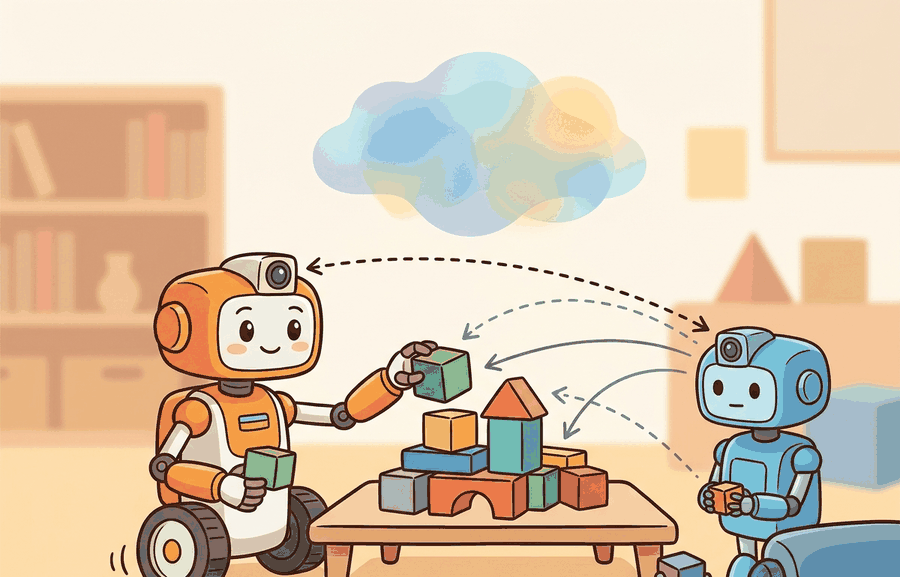
Shared perception and task allocation is the belief fusion and role assignment lens for multi-agent embodied AI. Teams need to combine partial views without pretending that every sensor is equally reliable or every robot is equally available.
shared perception and task allocation becomes useful when it is tied to a named interface, a replayable scenario, a failure diagnostic, and an artifact that records what changed in the action loop.
The key question is practical: How should the system fuse beliefs, assign tasks, and recover when one agent has stale or conflicting information?
A representation earns its place when it changes the measurable action interface. In shared perception and task allocation, the reader should keep asking which decision becomes easier, safer, or more reliable.
Theory
For Shared perception and task allocation, the practical design rule is to make the interface inspectable before optimization begins: inputs, outputs, units, latency, bounds, and failure labels should all be visible in the saved artifact.
The mechanism in Shared perception and task allocation is the contract between representation and action. Name what enters the module, what leaves it, which assumptions make that transformation valid, and which log would reveal a bad handoff.
Worked Example
Consider a search-and-rescue floor map. A drone sees rooms from above, a ground robot sees doorways and obstacles, and a coordinator must assign search regions without double-counting uncertain detections.
The hand-built fragment names observations and actions in about 12 lines. In practice, use ROS 2 messages, behavior trees, or auction-style task allocators with simulator playback; those tools handle typed state, timing, and dispatch while the small version clarifies what evidence each role contributes.
Practical Recipe
- Write the observation, action, and success metric before choosing a model.
- Build a baseline that is simple enough to debug by inspection.
- Add the library implementation only after the baseline behavior is understood.
- Record failures as structured cases: perception error, state error, planning error, control error, or evaluation error.
- Run at least one perturbation test before trusting the result.
The common mistake in Shared perception and task allocation is to celebrate the component score before checking the closed-loop handoff. The failure usually appears at the boundary: stale state, wrong frame, delayed action, saturated actuator, or metric that ignores the real task cost.
A shared perception system should log source agent, timestamp, confidence, frame, fused belief, assigned task, and reassignment cause. The reassignment cause is often the fastest path to debugging team brittleness.
Research is moving toward multi-robot scene graphs, decentralized mapping, and task allocation that accounts for uncertainty and battery, not only distance. Claims need evaluation on dynamic scenes, stale observations, and dropped agents.
HAPPO (Kuba et al., ICLR 2022) is directly applicable here because heterogeneous task allocation naturally produces agents with different observation and action spaces: a mapper, a manipulator, and a scout see and do different things. HAPPO's sequential trust-region update allows each specialist policy to improve without destabilizing its teammates, which is the theoretical property missing from earlier CTDE methods applied to heterogeneous role structures.
Can you name the observation, state estimate, action, success metric, and most likely failure mode for shared perception and task allocation? If not, the system boundary is still too vague.
Shared perception and task allocation becomes useful when it is tied to a closed-loop contract for Multi-Agent Embodied AI. The contract names the participants, observations, action authority, timing budget, logging artifact, and recovery rule. Without that contract, a system can look capable in a notebook while failing the first time a partner delays, a person corrects it, or a deployment scene changes.
For Shared perception and task allocation, separate the conceptual claim, the systems claim, and the evidence claim. A plausible mechanism, a clean interface, and a closed-loop result are different claims; the section should keep their evidence separate.
| Tool or Library | Role in the Topic | Builder Advice |
|---|---|---|
| PettingZoo | Shared perception and task allocation | Standardize multi-agent environment interfaces and compare turn-based with parallel interaction. |
| Gymnasium | Shared perception and task allocation | Keep single-agent baselines available before adding teammates or opponents. |
| ROS 2 | Shared perception and task allocation | Move team messages, robot state, and safety events through typed topics and services. |
| MuJoCo | Shared perception and task allocation | Prototype contact-rich robot interactions before running real hardware. |
| LeRobot | Shared perception and task allocation | Reuse robot datasets and policies when team behavior depends on demonstrations. |
For Shared perception and task allocation, the baseline and maintained-tool version should produce the same artifact schema and run on one task panel. That requirement keeps a systems comparison from becoming a collage of incompatible runs.
- Write a one-paragraph task contract with observation, action, success, and failure fields.
- Start with the smallest simulator, dataset, or wrapper that exposes the task contract faithfully.
- Run one deterministic smoke test and one perturbation test before scaling.
- Save a single result artifact containing configuration, seed, metrics, videos or traces, and failure labels.
- Compare methods only when one script evaluates them on the same task panel.
When Shared perception and task allocation fails, avoid labeling the whole method as weak. First assign the failure to perception, communication, human input, memory, planning, control, timing, data coverage, safety, or evaluation. Then rerun one controlled perturbation that isolates the suspected cause. This pattern turns a disappointing rollout into a reusable diagnostic asset.
Agent Checklist Applied
The 42-agent production pass treats shared perception and task allocation as a buildable system, not a definition. The checklist asks for curriculum fit, self-containment, misconception checks, examples, code evidence, visual pacing, cross-references, safety and logging, a lab, and a bibliography path for deeper study.
For Shared perception and task allocation, connect the agent-environment boundary, Gymnasium or PettingZoo interface, RL objective, hierarchy, and evaluation artifact through one multi-agent interaction log.
A common misconception is that fusing more observations always improves the world model. The diagnostic question is: what happens when the freshest observation is wrong and the older observation is right?
Simulate three agents reporting object locations with different delays. Assign tasks using nearest-agent routing, then repeat with confidence and timestamp weighting.
Shared perception is not a democracy; a bad timestamp should not get an equal vote.
Technical Core
Shared perception and task allocation needs a topic-native core: variables, equations or system contracts, an algorithmic procedure, an expected output, and a failure diagnosis. Figure 49.3.T summarizes the chain this section must preserve when moving from a teaching example to a real embodied system.
$\min_{x_{ij}\in\{0,1\}}\sum_{i=1}^N\sum_{j=1}^M c_{ij}x_{ij},\quad \sum_j x_{ij}\le 1,\quad \sum_i x_{ij}=1$
Shared perception and task allocation couple estimation with combinatorial decision making. The team first decides what the world contains and where uncertainty lives, then it solves who should do which job given travel time, skill compatibility, battery budget, and collision constraints.
- Fuse detections into a shared object graph with timestamps, confidence, and frame transforms.
- Prune stale observations and reconcile duplicates before any task is assigned.
- Build an agent-task cost matrix from reachability, travel time, and manipulation affordance.
- Solve the assignment, then replan whenever the fused map changes beyond a threshold.
| Input | Typical Source | Why It Must Be Logged |
|---|---|---|
| Pose confidence | Multi-view perception stack | Low confidence often explains bad task claims better than bad control. |
| Travel-time estimate | Navigation map and planner | Prevents assigning the closest-looking robot instead of the fastest one. |
| Skill label | Manipulator or tool capability model | Explains why some jobs are infeasible, not merely low reward. |
| Reassignment count | Execution monitor | Reveals whether the allocator is stable under scene change. |
The useful part is the explicit cost decomposition. If the team later fails, you can ask whether the wrong robot was assigned because the object pose was wrong, the travel-time estimate was stale, or the capability model claimed a skill the robot did not really have.
Allocation fails when the shared map is treated as ground truth. Always perturb timestamps, duplicate one detection, and move one target object after assignment to test whether the fusion-and-assignment loop can recover without thrashing.
Shared perception helps when fusion preserves uncertainty and task allocation respects robot limits.
Design a method-matched experiment for Shared perception and task allocation. Specify the environment, observation schema, action interface, metric, and one perturbation that targets the section's core assumption.
Section References
Lowe, R. et al. Multi-Agent Actor-Critic for Mixed Cooperative-Competitive Environments. NeurIPS, 2017.
Use for centralized-training, decentralized-execution baselines and communication or coordination failure analysis.
Terry, J. K. et al. PettingZoo: Gym for Multi-Agent Reinforcement Learning. NeurIPS Datasets and Benchmarks, 2021.
Use for maintained multi-agent environment interfaces and reproducible API-level examples.