"Choosing an action space is how you tell a robot what kinds of mistakes it is allowed to make."
A Cautious Policy Interface
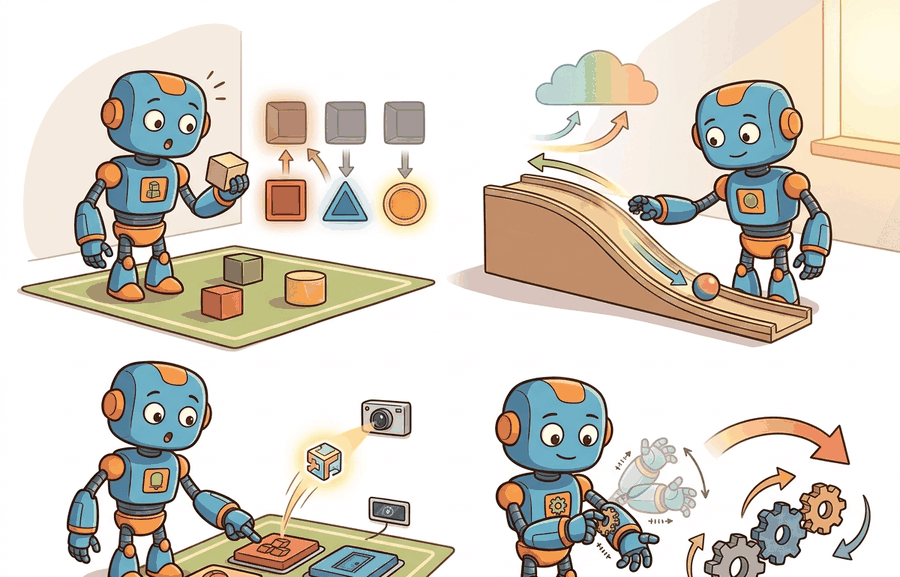
Action types: discrete, continuous, symbolic, motor-level, chunked define what the agent can actually do. The same task can be framed as choosing a skill, setting a velocity, moving a joint, emitting a language-conditioned action token, or committing to a short action chunk.
This section develops a design checklist for action representation. Action spaces are not interchangeable wrappers around a model. They define controllability, safety, latency, data requirements, transfer difficulty, and how quickly an agent can recover from an error.
Discrete actions are easy to enumerate, symbolic actions are useful for planning, continuous actions match motors and physics, motor-level actions expose control detail, and chunked actions reduce inference frequency while increasing commitment. OpenVLA-style systems add another pattern: map image and language context to action tokens or continuous control heads that must still respect robot limits.
The action representation decides which layer owns intelligence. A symbolic action delegates execution to skills. A motor command delegates almost nothing. A chunked action delegates timing to the policy for several future steps.
Theory
Let the action space be $\mathcal{A}$. A discrete $\mathcal{A}$ might contain actions such as open, close, or move-left. A continuous $\mathcal{A}$ might be a vector of joint torques, velocities, or end-effector pose deltas. A symbolic $\mathcal{A}$ might contain calls such as pick(red_block). A chunked $\mathcal{A}$ contains sequences of low-level actions emitted at once.
The right action space depends on embodiment and timing. A high-level action can be easier to learn but hides safety-critical details. A low-level action can be precise but makes long-horizon reasoning harder. A chunked action can smooth robot motion and reduce model calls, but it delays correction if the world changes mid-chunk.
Every action needs units, limits, rate, coordinate frame, validity checks, and execution semantics. A delta pose in the end-effector frame is different from a target pose in the world frame. A gripper command can mean binary open-close, continuous width, or force-controlled closure.
Worked Example
Code Fragment 2.3.1 compares four action representations for the same tabletop instruction. Notice that each representation shifts responsibility to a different layer of the system.
# Section 2.3: runnable checkpoint for Action types: discrete, continuous, symbolic, motor-level,
# chunked.
# Keep the output small so the evidence record can be inspected directly.
action_spaces = {
    "discrete_skill": ["find_object", "grasp", "place"],
    "symbolic_call": "place(red_block, tray)",
    "continuous_delta": {"dx_m": 0.01, "dy_m": -0.02, "dz_m": 0.00, "grip": 0.7},
    "chunked_delta": [
        {"dx_m": 0.01, "grip": 0.5},
        {"dx_m": 0.01, "grip": 0.7},
        {"dx_m": 0.00, "grip": 0.9},
    ],
}
for name, action in action_spaces.items():
print(name, action)The 14-line comparison becomes one action-space declaration in Gymnasium, one policy configuration in LeRobot, or one action adapter in an OpenVLA-style inference service. The tools handle validation, normalization, batching, and model I/O. The hand-built version remains useful because it exposes units, frames, limits, and chunk length.
Practical Recipe
- Start from the actuator, safety monitor, and controller rate, then move upward to skills.
- Choose the coarsest action that still allows timely recovery.
- Record units, bounds, coordinate frame, rate, and clipping behavior.
- Test action latency by injecting delay and measuring recovery.
- Report action validity failures separately from task failures.
A high-level action such as pick can hide dangerous low-level motion. A motor-level action can be safe but too hard for long-horizon planning. A chunked action can improve smoothness while delaying correction after a slip, occlusion, or human interruption.
A service robot team first used symbolic actions for cleaning tasks, then found that furniture avoidance needed continuous velocity control near chair legs. They kept symbolic planning for task order, continuous control for local motion, and a safety monitor that clipped speed near people.
An action space is like a steering wheel: too small and you cannot maneuver, too large and the learner spends half the drive discovering the curb.
Vision-language-action models, action chunking, diffusion policies, and flow-based policies explore different action parameterizations. The practical question is not which representation is most fashionable, but which one meets the embodiment, latency, safety, and recovery requirements.
Take a simple pick-and-place task and write three action interfaces: symbolic skill, end-effector delta, and chunked delta. For each, define the controller that must sit below it.
Can you state your action units, coordinate frame, update rate, action bounds, and clipping behavior without inspecting the policy code?
Action representation is an architectural boundary. A symbolic skill shifts burden to a planner and skill library. An end-effector delta shifts burden to a controller and calibration stack. A joint command shifts burden to the learned policy and safety monitor. A chunked action shifts burden to prediction because the policy commits before seeing every intermediate consequence.
The practical question is not which action type is most elegant. It is which layer should own timing, contact, validity checking, and recovery for the task at hand.
| Tool or Library | Role in This Topic | Builder Advice |
|---|---|---|
| Gymnasium spaces | declares discrete, continuous, multi-discrete, dictionary, and bounded action structures | Use spaces as executable documentation for units, bounds, shapes, and clipping behavior. |
| ROS 2 controllers | execute velocity, position, effort, and trajectory commands under real timing constraints | Use them to check whether the action representation can be executed safely at deployment rate. |
| LeRobot and VLA action adapters | normalize robot actions, action chunks, and policy outputs into deployable commands | Use them when learned action heads must be mapped back to body-specific controllers. |
Audit an action interface before training. The audit should fail if units, frames, rates, bounds, or chunk semantics are absent.
- Name the action level: symbolic, skill, end-effector, joint, torque, velocity, or chunked sequence.
- Record units, coordinate frame, bounds, update rate, controller below the action, and clipping behavior.
- Define what happens when a command is invalid or stale.
- Inject saturation, delay, and mid-chunk observation changes.
- Report action validity failures separately from policy-task failures.
# Audit an action interface for fields needed by a real controller.
action_interface = {
    "level": "end_effector_delta",
    "units": {"dx": "m", "dy": "m", "dz": "m", "yaw": "rad"},
    "frame": "tool0",
    "rate_hz": 20,
    "bounds": {"dx": 0.02, "dy": 0.02, "dz": 0.015, "yaw": 0.10},
    "clip_behavior": "clip_and_log",
    "controller_below": "cartesian_impedance",
}

def missing_action_contract(interface: dict[str, object]) -> list[str]:
    required = ["level", "units", "frame", "rate_hz", "bounds", "clip_behavior", "controller_below"]
    return [key for key in required if key not in interface]

print(missing_action_contract(action_interface))When an action interface fails, ask whether the command was invalid, clipped, stale, in the wrong frame, too coarse, too low-level, or too committed through chunking. Those are different failures and should not be collapsed into "bad policy."
Hands-On Lab: Audit An Action Interface
Objective
Build an action-interface contract for one task and test how clipping, delay, or chunking would change recovery.
What You'll Practice
- Define action units, bounds, frames, and update rate
- Detect missing execution fields before policy training
- Log raw commands, executed commands, and clipping
- Compare correction delay for single-step and chunked actions
Setup
pip install numpy pandasSteps
Step 1: Define the action contract
Write the execution fields before choosing a policy.
Hint
If a controller cannot execute the command, the action representation is not finished.
Step 2: Check for missing execution fields
Audit the contract before running a policy.
required = {"level", "units", "frame", "rate_hz", "bounds", "clip_behavior"}
missing = sorted(required - contract.keys())
assert not missing, f"Action contract missing fields: {missing}"
print({"contract_ready": True, "rate_hz": contract["rate_hz"], "bounds": contract["bounds"]})Hint
Most action bugs hide in units, frames, bounds, and silent clipping.
Step 3: Simulate clipping
Test whether out-of-bounds commands are visible in the log.
command = {"dx": 0.05, "dy": 0.00, "dz": 0.00, "grip": 0.6}
clipped = {**command, "dx": min(command["dx"], contract["bounds"]["dx"])}
clip_amount = command["dx"] - clipped["dx"]
assert clip_amount >= 0.0
print({"raw_dx": command["dx"], "executed_dx": clipped["dx"], "clip_amount": round(clip_amount, 3)})Hint
A clipped command is not the action the policy selected. Log both.
Step 4: Compare commitment length
Record how long the system must continue before it can correct a bad command.
interfaces = [
    {"name": "single_delta", "chunk_len": 1, "rate_hz": 20},
    {"name": "five_step_chunk", "chunk_len": 5, "rate_hz": 20},
]
for item in interfaces:
    item["commitment_ms"] = 1000 * item["chunk_len"] / item["rate_hz"]
print(interfaces)Hint
Chunking can smooth control, but it also delays recovery when observations change.
Expected Output
The completed lab produces a compact action-interface audit showing whether the contract is complete, whether clipping is visible, and how long a chunked command delays correction.
Stretch Goals
- Add a joint-level version and compare its bounds against the end-effector version.
- Add a stale-command rule that holds position when the command age exceeds the control budget.
Complete Solution
The action space is a design commitment. It decides how intelligence, safety, timing, and recovery are divided across the embodied stack.
Design three action spaces for opening a drawer: one symbolic, one end-effector-level, and one joint-level. State one advantage and one risk for each.
What's Next?
Section 2.4 connects those action choices to reward functions, task specifications, and constraints.
Bibliography & Further Reading
Foundational References For This Section
Bellman, R.. "A Markovian Decision Process." (1957). https://doi.org/10.1515/9781400835386-007
The mathematical origin of the state, action, transition, and reward framing.
Kaelbling, L. P., Littman, M. L., and Cassandra, A. R.. "Planning and acting in partially observable stochastic domains." (1998). https://www.sciencedirect.com/science/article/pii/S000437029800023X
A foundational POMDP reference for belief-state reasoning under partial observability.
Farama Foundation. "Gymnasium Documentation." (2024). https://gymnasium.farama.org/
The maintained reference for reset, step, spaces, termination, truncation, wrappers, and reproducible environments.