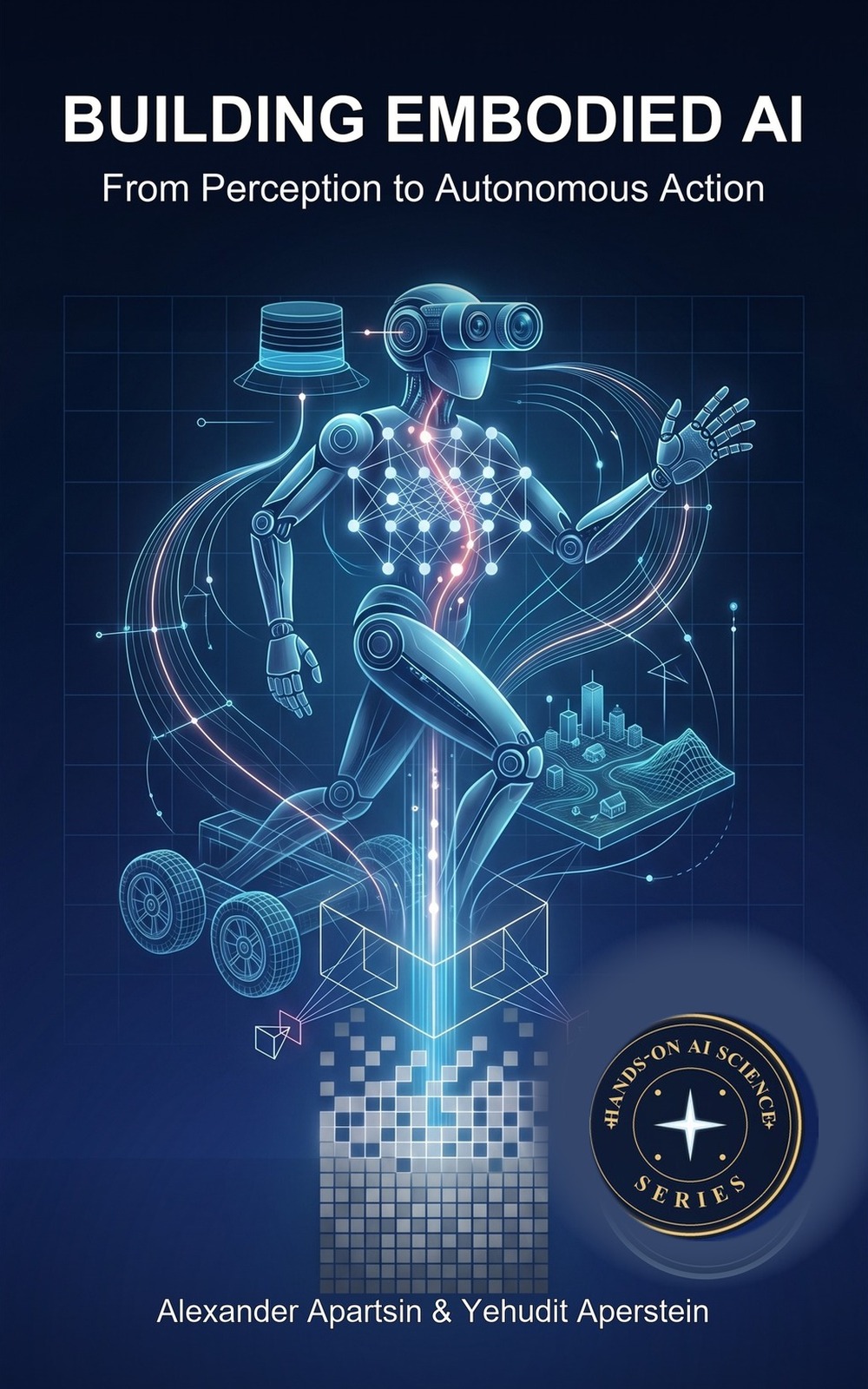
Building Embodied AIFrom Perception to Autonomous Action
A practitioner's guide to embodied agents, robot learning, simulation, world models, and physical intelligence.
Embodied intelligence begins when an agent's computation is inseparable from its body. The sensors determine what the world looks like; the actuators determine what can be changed; the physics determine what the consequences will be. This book is one connected journey through that full stack: robotics and control, simulation, reinforcement and imitation learning, vision-language-action models, world models, humanoids, safety, and deployment.
The Twelve-Part Arc
Each part adds one layer to the agent that senses, predicts, decides, acts, and learns.
Foundations of Embodied AI
The conceptual vocabulary of agents, environments, embodiment, and closed-loop intelligence.
3 chapters · 24 sections IIMathematical, Robotics, and Control Foundations
The geometry, kinematics, dynamics, control, and sensing that make physical agents intelligible.
5 chapters · 36 sections IIISimulation, Tooling, and the Modern Stack
The simulators, environments, benchmarks, and synthetic-data practices used to build embodied systems today.
5 chapters · 32 sections IVReinforcement Learning for Embodied Agents
Interaction-driven learning, from policy gradients and off-policy methods to safe exploration and sim-to-real transfer.
7 chapters · 37 sections VLearning from Demonstration and Robot Data
Imitation learning, teleoperation, action chunking, diffusion policies, robot datasets, and the data-scaling laws that drive modern robot learning.
6 chapters · 33 sections VIEmbodied Perception
Vision, 3D understanding, localization, mapping, and navigation as perception for action.
4 chapters · 27 sections VIILanguage, Vision, and Action
Language-guided agents, VLMs, LLM planners, VLAs, and cross-embodiment foundation models.
5 chapters · 35 sections VIIIWorld Models and Model-Based Embodied AI
Prediction, latent dynamics, model-based control, generative worlds, and diffusion planning.
6 chapters · 32 sections IXManipulation, Locomotion, and Embodied Skills
Hands, legs, humanoids, drones, vehicles, and the skills that let agents move through the world.
7 chapters · 39 sections XMulti-Agent and Human-Centered Embodiment
Teams of agents, humans in the loop, open worlds, and lifelong interaction.
3 chapters · 16 sections XIEvaluation, Safety, Robustness, and Deployment
Metrics, uncertainty, safety filters, deployment architecture, and operational discipline.
4 chapters · 21 sections XIIFrontiers, Capstones, and Course Design
Memory, continual learning, open problems, capstone projects, and teaching paths.
5 chapters · 31 sectionsHow This Book Teaches
Five habits, kept in every chapter from the first simulator to the final deployment.
Worked Systems
Every chapter connects concepts to a runnable artifact, from a tiny environment to a robot-learning pipeline.
Library Shortcuts
After each from-scratch build, a shortcut names the maintained tool that makes the practical version small.
A Callout System
Failure modes, research frontiers, recipes, and cross-references are typeset as distinct boxes for fast scanning.
Exercises And Labs
Chapters close with build tasks that turn theory into testable systems.
Classical Ideas Return Learned
Geometry, control, estimation, and simulation reappear inside modern learned policies and world models.
The Hands-On AI Science Series
Building Embodied AI is one of nine connected books, each a deep, build-it-yourself guide to a major field of AI.
Hands-On AI Science is a series of in-depth guides to the major fields of artificial intelligence. Every book goes deep into the theory, models, and internals, covers the classical foundations and the most recent ideas, then shows how to build each one in Python with modern libraries and tools.
Building Embodied AI
From Perception to Autonomous Action.
You are hereRead the full About the Hands-On AI Science Series note.